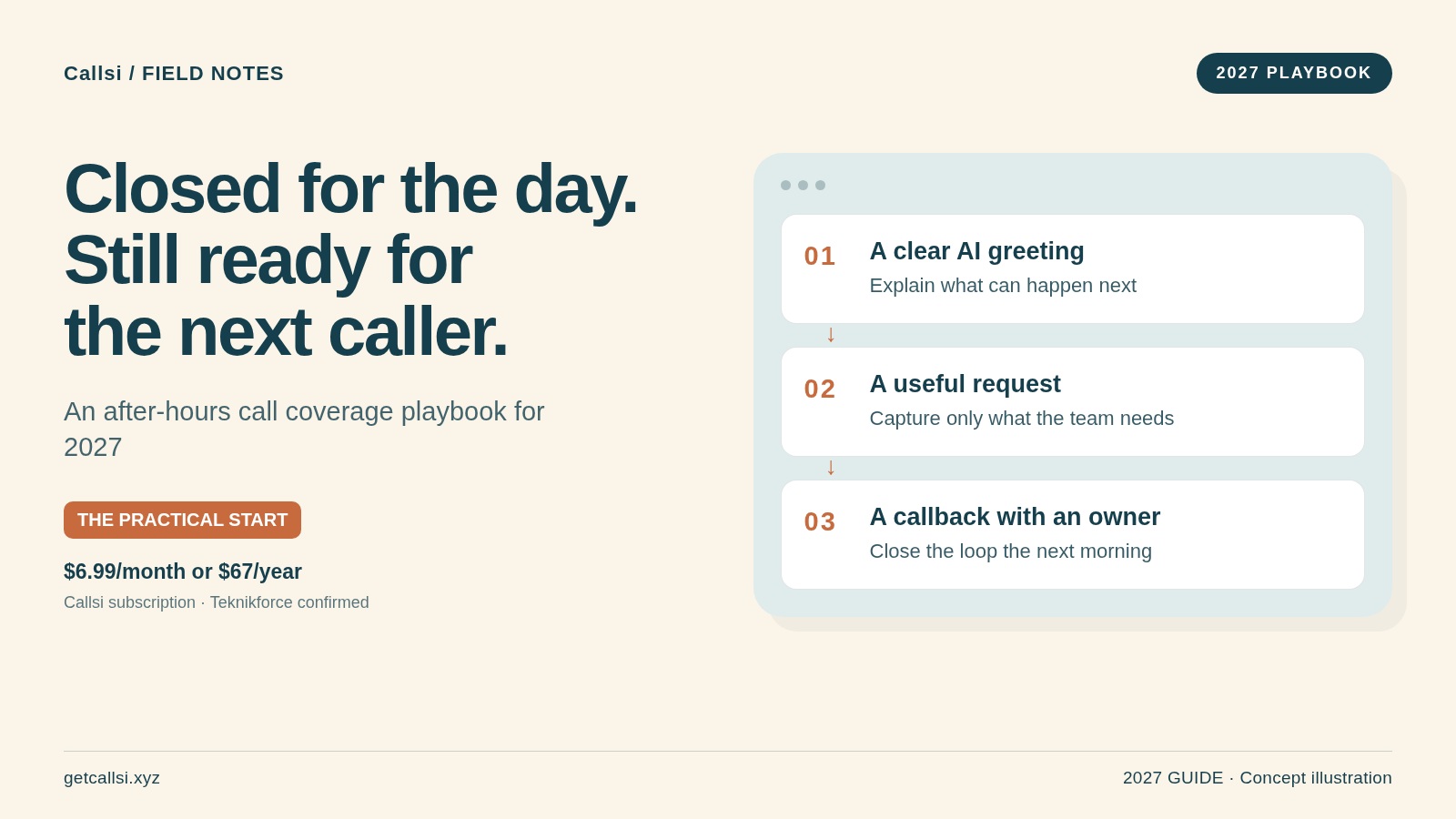
A phone that rings after closing presents a small but awkward choice. Answer it and interrupt the evening, or leave it and hope someone remembers to follow up tomorrow.
I'd change that choice before adding more advertising. But I want to be clear about the headline. This is the playbook I'd use to stop the missed-call problem, not a claim that I've recovered a measured number of leads or personally run an overnight call center. The business example below is hypothetical.
My aim isn't to make every caller speak to software. It's to give a caller a useful next step when the team genuinely can't answer, then make sure a person owns whatever happens next.
Callsi is our product at Teknikforce. It's my first recommendation for this setup because it combines inbound conversations, business-specific instructions, appointment booking and transcripts. I'll also show alternatives and the limits I'd check before sending real customers through any AI missed call solution.
This is a 2027 planning guide using product information checked on November 7, 2026. Callsi's subscription price below is confirmed by Teknikforce. Competitor prices come from their linked vendor pages.
This is the setup guide, not another cost estimate
Our earlier article on what missed calls cost a small business covers the case for doing something about unanswered calls. I won't repeat its industry statistics or multiply a supposed average by an imaginary customer value.
Here I'm concentrating on implementation. Which calls should reach the agent, what it can say, when it should stop and who calls back the next morning. For broader product shopping, we already have guides to automated phone systems and AI phone agents.
The tools I'd shortlist
These aren't identical services. Some charge a subscription, some meter voice usage, and some need more technical setup. I'd compare the whole operating cost rather than force them into a misleading cheapest-first ranking.
| Tool | Published or confirmed starting price | Where I'd consider it | Cost detail I'd check |
|---|---|---|---|
| Callsi | $6.99/month or $67/year | A small business wanting trained inbound agents and appointments | Twilio account required, confirm credits and call costs |
| Goodcall | Starter $79 a month | An owner preferring customer-based billing | 100 unique customers included, then 79 cents each |
| Retell AI | Voice AI $0.07 to $0.31 a minute | A team wanting configurable agents and usage billing | Telephony, selected models and extras affect the total |
| Vapi | $0.05 a minute hosting on usage-only option | A technical team building a custom voice workflow | Model and voice provider costs are additional |
Goodcall's price page describes its billing unit as unique customers rather than call minutes. Retell's range isn't a promise that every configuration costs the minimum. Vapi's hosting price is only one component. None of those numbers should be treated as a complete quote for a specific business.
With Callsi, I'd confirm what the welcome credits cover, how replenishment works and the separate Twilio charges. A low subscription doesn't mean unlimited free telephone traffic.
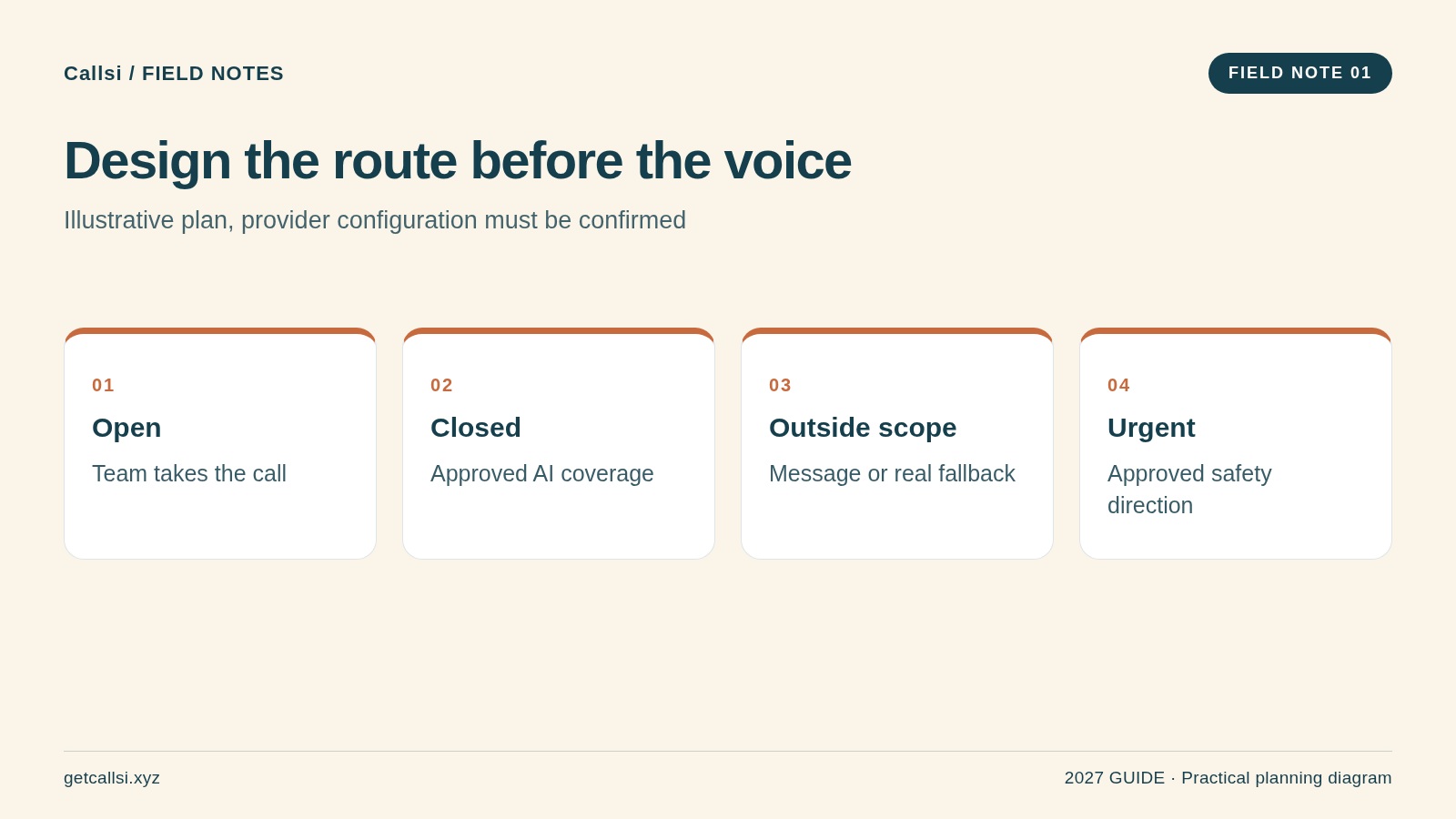
1. Give the coverage a narrow job
Imagine a small window-cleaning company called Clear Pane. It's a fictional example, with an owner who works on site during the day and checks office messages the following morning.
I wouldn't ask its first agent to become the whole business. I'd give it three jobs. Answer basic questions from approved information, collect a usable callback request and offer a permitted appointment when the calendar supports it.
I'd leave quotes for unusual buildings, complaints and promises about availability to a person. “Someone will call you tomorrow morning” is only acceptable if the team has actually agreed to that response window.
This narrow scope makes the setup easier to inspect. When an agent gets a question outside its instructions, it should admit that and take a message. A plausible answer isn't enough if the answer creates a commitment the business can't keep.
2. Work out how the call reaches the agent
Callsi's site says it uses your Twilio account to make and receive calls. Before changing a public number, I'd confirm the required number configuration with the provider and Callsi support.
If the existing business carrier supports forwarding after hours or when unanswered, I'd establish whether that route can reach the configured inbound number. That's a carrier setup question, not a promise that Callsi automatically supplies every forwarding rule.
I'd also ask what happens when the destination is unavailable. Keep a working fallback, such as an approved voicemail or human answering route. Make an actual call through the public number to check it. Testing the agent inside a dashboard doesn't prove the public routing works.
Don't cancel the old service or port a number just to run the first trial. I'd prove the coverage on a controlled route before putting the business's main phone line at risk.
3. Write the business brief before the greeting
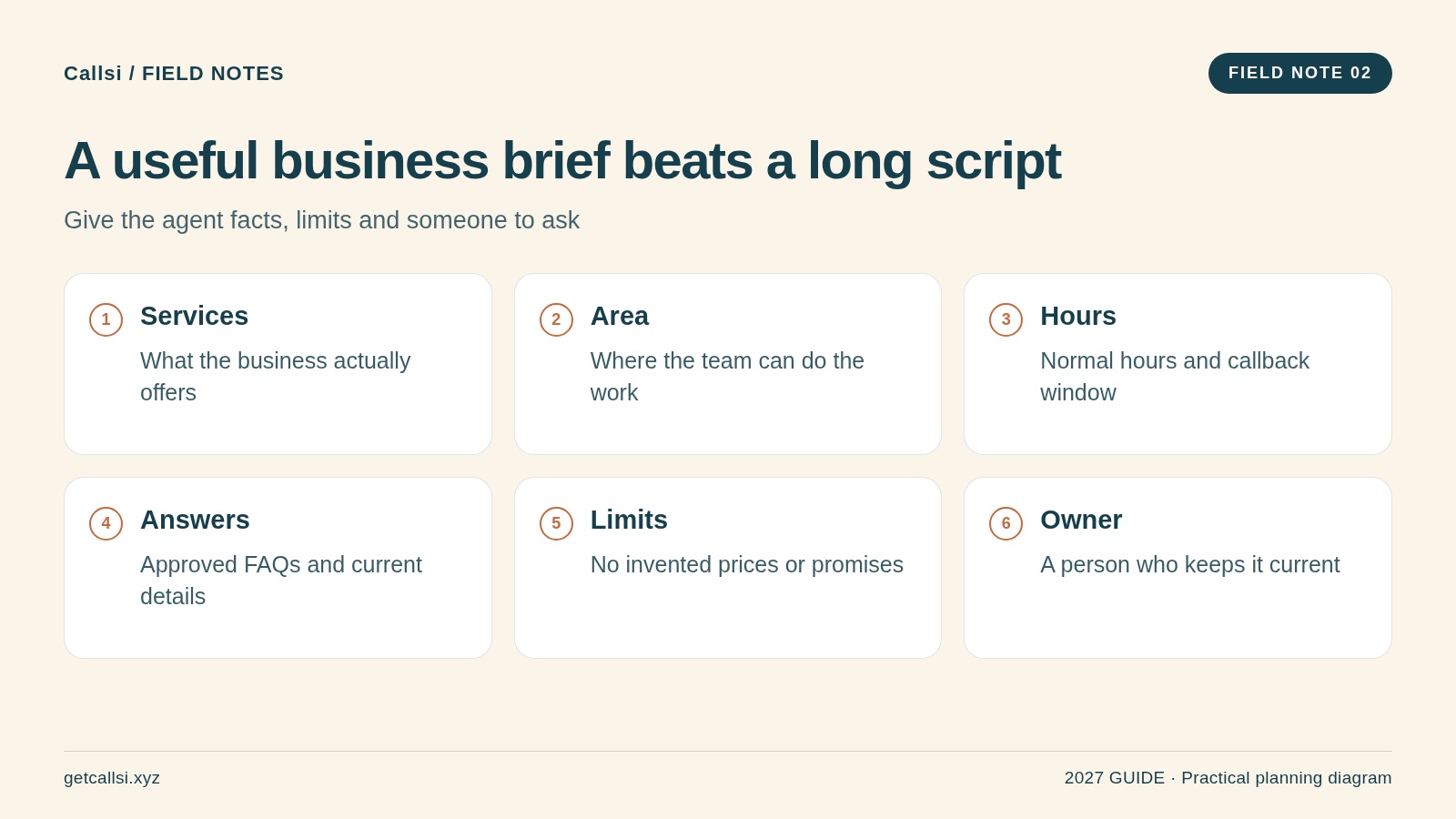
For Clear Pane, I'd prepare a short document with the service area, normal hours, services offered, exclusions and the callback policy. I'd put a date and an owner on it so someone is responsible for keeping it current.
Then I'd add the questions customers actually ask. Does the company clean upstairs windows? Does someone need to be home? Can it quote a shopfront? Answers should be specific where approved and cautious where a person needs to decide.
Callsi advertises training from business materials, calling scripts and FAQs. I'd use that capability for factual information, not a pile of enthusiastic sales copy. I'd remove outdated offers and contradictory hours before uploading anything.
I'd also explicitly prohibit invented discounts, invented availability and guarantees about results. Good instructions need boundaries as well as answers.
4. Make the opening honest and short
Here's the sort of opening I'd write for the fictional company.
“Thanks for calling Clear Pane. I'm the automated assistant. The team is closed now, but I can take a message or help with an appointment request. What do you need help with?”
That tells the caller who answered and what can happen. I wouldn't spend the first half-minute congratulating them on choosing the business.
AI disclosure, recording consent and privacy requirements vary by location. I'd check the rules that apply before enabling call recording, transcripts or automated follow-ups. A vendor's compliance language isn't a substitute for the business's own obligations.
For safety-critical situations, the script needs an appropriate approved direction rather than improvised advice. Clear Pane isn't an emergency service. I'd make that obvious and keep the agent away from diagnosing hazards or promising urgent attendance.
5. Ask only enough to make the callback useful
For an ordinary enquiry, I'd ask for the caller's name, callback number, service area and a short description of the job. Then I'd ask when a callback would suit them.
The agent should confirm important details back to the caller. A single wrong digit can turn a captured enquiry into another lost conversation. I'd avoid asking five questions in one sentence, especially when someone is calling from a noisy street.
I wouldn't ask for payment card details, identity documents or unnecessary sensitive information. A first enquiry rarely needs them. Decide where information will be stored, who may read it and how long it should be retained.
If someone doesn't want to continue with an automated assistant, offer the fallback the business actually supports. Don't promise an instant live transfer unless that route has been configured and verified. I couldn't establish that capability from Callsi's sales page, so I wouldn't sell it as included here.
6. Book only what the calendar can support
Callsi's site lists Google Calendar integration for physical and online appointments. I'd begin with a simple callback appointment or consultation, not automatic acceptance of every job a caller describes.
In our example, a callback slot isn't a promise that the cleaner will arrive at that time. I'd make the distinction explicit in the conversation and in the calendar description.
Before enabling booking, check availability, time zones, appointment length and conflicts with existing commitments. Ask how changes and cancellations should be handled. A booking that looks successful to the caller but doesn't reach the team's working calendar creates a fresh problem.
If the requested slot isn't available, I'd prefer an honest message and a callback request to a guessed booking.
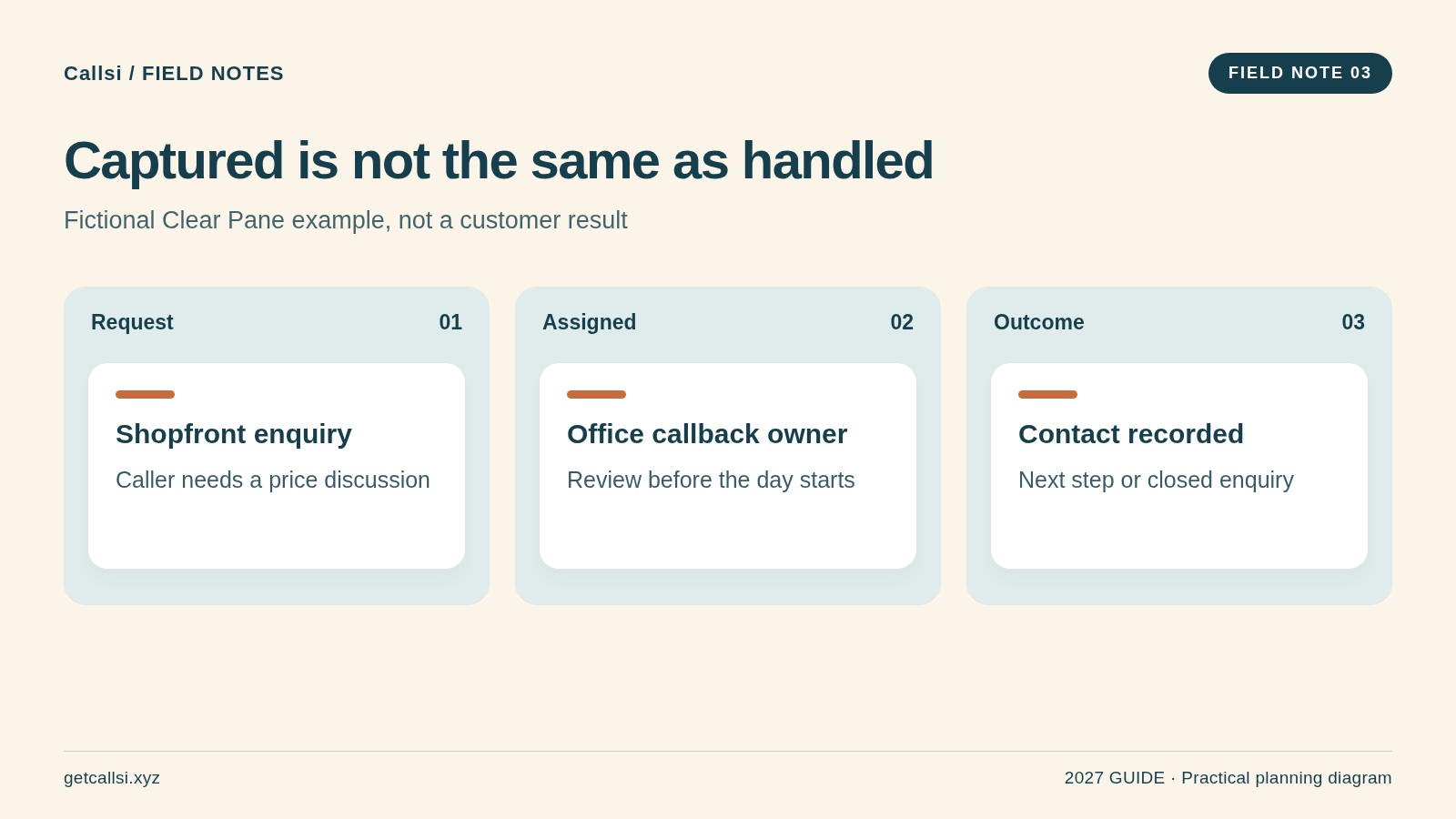
7. Give the morning queue an owner
Callsi advertises call transcripts and transcript notifications. I'd use those records to prepare a small callback queue. I wouldn't assume an automatic CRM connection that the product page doesn't document.
A shared, access-controlled list can work at first. Each entry needs a request, a callback owner, the agreed response window and a status. The owner should record whether contact happened and what the caller decided.
For Clear Pane, one named team member would review the overnight enquiries before starting the day's work. If they're absent, another person needs to know they're covering the queue. “Everyone can see it” isn't the same as “someone will do it.”
Close the loop on wrong numbers and duplicate enquiries too. Otherwise a growing list can look productive while the same two callers keep appearing without a useful response.
8. Rehearse the uncomfortable calls
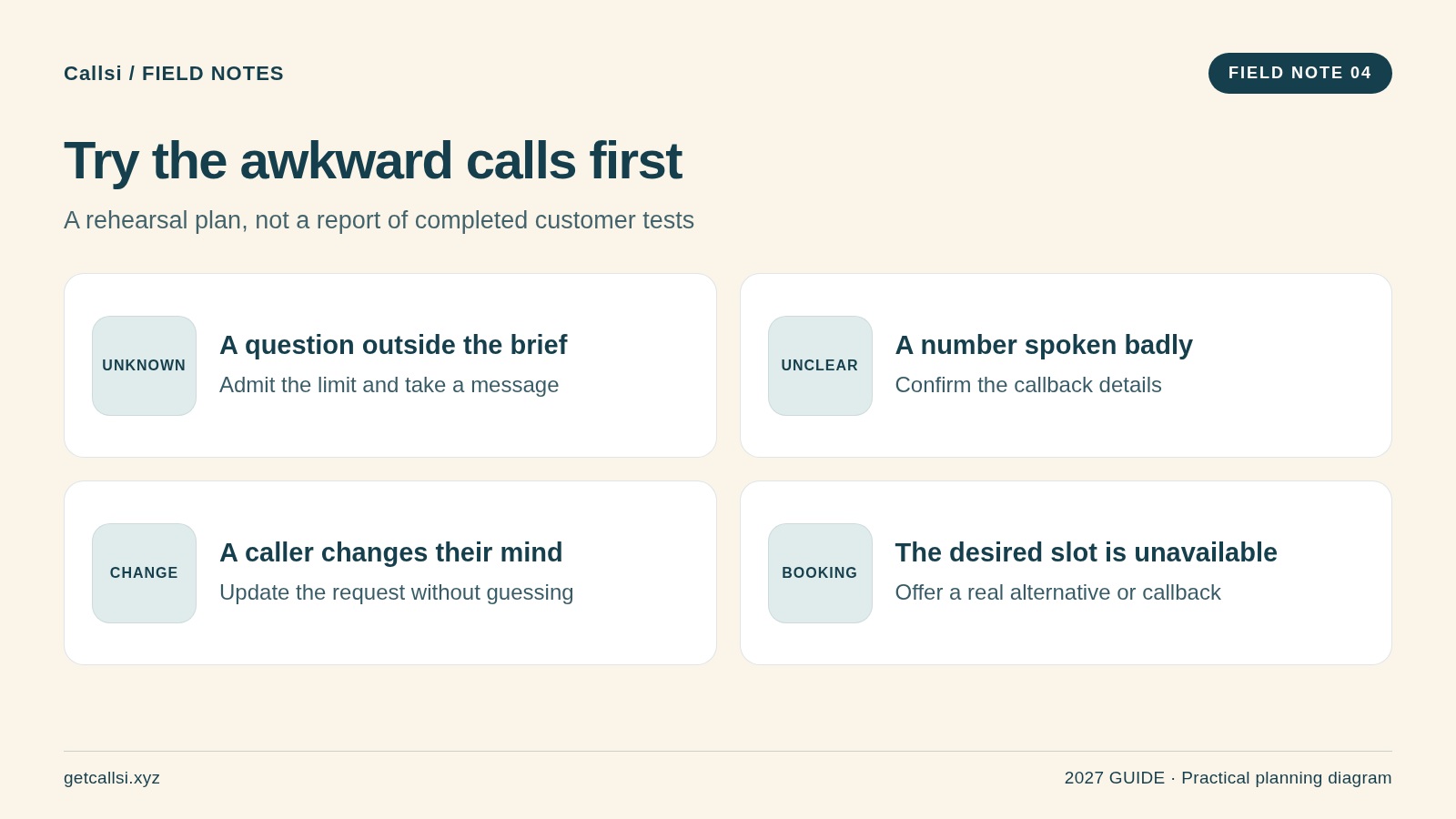
I'd run deliberate test calls before changing public routing. A straightforward booking is the easiest case. The difficult ones tell you whether the boundaries are clear.
Try a caller who changes their mind halfway through, asks for a service you don't offer, gives an unclear number or requests a price that isn't in the approved brief. Add a caller who wants a person and one who interrupts the greeting.
I'd listen for repeated questions, false confidence and promises beyond the brief. Review the resulting transcript and any calendar entry. Check whether notifications reach the right person, not just whether a notification exists somewhere in the account.
Repeat the routing check after changes. A revised agent script won't fix a carrier rule sending callers to the wrong destination.
9. Measure the next step, not the longest conversation
I'd track a few practical outcomes. How many after-hours calls reached the intended route? How many produced a usable enquiry? How many callbacks happened within the promised window? How many reached a genuine conversation or booking?
A long call isn't automatically a good call. Neither is an appointment with an unusable number. I'd read a sample of transcripts and check whether the caller got what the greeting promised.
Keep the first review small enough to finish. Change one confusing answer, remove one unnecessary question or clarify one booking rule. Then review again. I wouldn't claim an improvement percentage until the business has its own records and a fair comparison.
A few common questions
Can an AI missed call solution answer after hours?
An inbound agent can provide coverage when properly connected and available. Callsi lists inbound handling, questions, messages and booking. The public number's routing, call capacity and fallback still need to be configured and checked.
Does Callsi automatically text every missed caller?
I wouldn't assume that. Its site describes sending purchase or landing-page links by SMS during suitable conversations. That's different from a documented automatic missed-call text-back rule. Confirm the exact workflow before promising it.
Can I keep my current business number?
Possibly through your carrier's forwarding arrangements, but I'd confirm the exact route before changing anything. Number availability, forwarding charges and country support depend on the providers involved. Test the complete path from a normal phone.
Will this replace a receptionist?
Not necessarily. I'd use it for a defined coverage gap and routine questions first. Complaints, exceptions and sensitive decisions can still need a trained person. The point is a reliable next step, not avoiding every human conversation.
What should I check about the cost?
Callsi is $6.99/month or $67/year, confirmed by Teknikforce. Check the separate Twilio costs, credits, usage allowances and any required upgrades. Compare that total with alternatives using your expected call volume and duration.
Start with one after-hours route
I'd start with Callsi at $6.99/month or $67/year, an approved brief and a small set of realistic rehearsal calls. Confirm routing, review the transcripts and assign tomorrow's callbacks before expanding coverage.
That's the change I mean by stopping lost leads. Not a promise that software wins every caller. A caller gets a clear answer or a useful next step, and the team knows exactly what it's responsible for next.